Trump’s
Russian Laundromat
How to use Trump Tower and other
luxury high-rises to clean dirty money, run an international crime syndicate,
and propel a failed real estate developer into the White House.
|
|
|||
|
ILLUSTRATION BY ALEX NABAUM |

In 1984, a Russian
émigré named David Bogatin went shopping for
apartments in New York City. The 38-year-old had arrived in America seven years
before, with just $3 in his pocket. But for a former pilot in the Soviet
Army—his specialty had been shooting down Americans over North Vietnam—he had
clearly done quite well for himself. Bogatin wasn’t
hunting
for a place in Brighton Beach, the Brooklyn enclave known as “Little Odessa”
for its large population of immigrants from the Soviet Union. Instead, he was
fixated on the glitziest apartment building on Fifth Avenue, a gaudy, 58-story
edifice with gold-plated fixtures and a pink-marble atrium: Trump Tower.
A
monument to celebrity and conspicuous consumption, the tower was home to the
likes of Johnny Carson, Steven Spielberg, and Sophia Loren. Its brash,
38-year-old developer was something of a tabloid celebrity himself. Donald
Trump was just coming into his own as a serious player in Manhattan real
estate, and Trump Tower was the crown jewel of his growing empire. From the day
it opened, the building was a hit—all but a few dozen of its 263 units had sold in the
first few months. But Bogatin wasn’t deterred by the
limited availability or the sky-high prices. The Russian plunked down $6
million to buy not one or two, but five luxury condos. The big check apparently
caught the attention of the owner. According to Wayne Barrett, who investigated the
deal for the Village Voice, Trump
personally attended the closing, along with Bogatin.
If the transaction seemed suspicious—multiple apartments for a single buyer who
appeared to have no legitimate way to put his hands on that much money—there
may have been a reason. At the time, Russian mobsters were beginning to invest
in high-end real estate, which offered an ideal vehicle to launder money from
their criminal enterprises. “During the ’80s and ’90s, we in the U.S.
government repeatedly saw a pattern by which criminals would use condos and
high-rises to launder money,” says Jonathan Winer, a
deputy assistant secretary of state for international law enforcement in the
Clinton administration. “It didn’t matter that you paid too much, because the
real estate values would rise, and it was a way of turning dirty money into
clean money. It was done very systematically, and it explained why there are so
many high-rises where the units were sold but no one is living in them.” When
Trump Tower was built, as David Cay Johnston reports in The Making of Donald Trump, it was only
the second high-rise in New York that accepted anonymous buyers.
In 1987, just three years after he attended the
closing with Trump, Bogatin pleaded guilty
to taking part in a massive gasoline-bootlegging scheme with Russian mobsters.
After he fled the country, the government seized his
five condos at Trump Tower, saying that he had purchased them to “launder
money, to shelter and hide assets.” A Senate investigation into organized crime
later revealed that Bogatin was a leading figure in the Russian mob in New
York. His family ties, in fact, led straight to the top: His brother ran a $150
million stock scam with none other than Semion Mogilevich, whom the FBI considers the
“boss of bosses” of the Russian mafia. At the time, Mogilevich—feared
even by his fellow gangsters as “the most powerful mobster in the world”—was
expanding his multibillion-dollar international criminal syndicate into
America.
|
|
MAXIM BLOKHIN/TASS
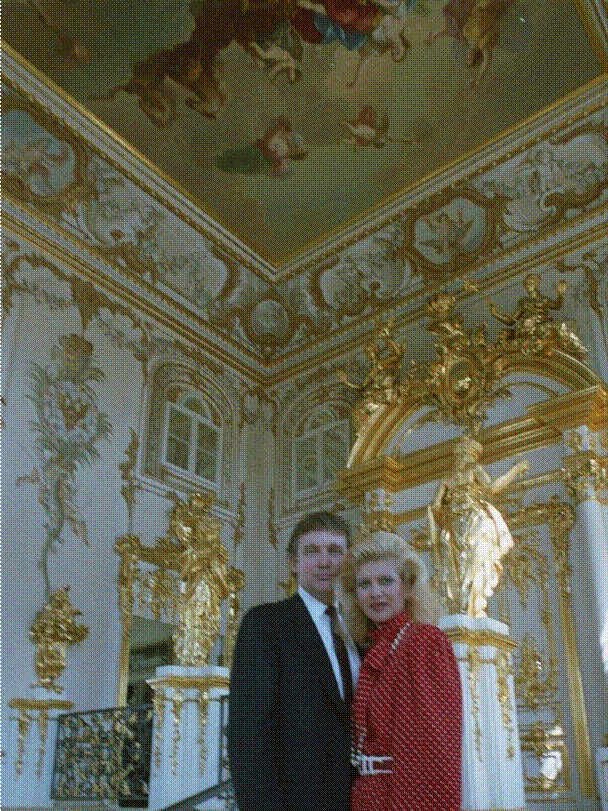
In 1987, on his first trip to Russia, Trump visited the Winter
Palace with Ivana. The Soviets flew him to Moscow—all expenses paid—to discuss
building a luxury hotel across from the Kremlin. |
Since
Trump’s election as president, his ties to Russia have become the focus of
intense scrutiny, most of which has centered on whether his inner circle colluded
with Russia to subvert the U.S. election. A growing chorus in Congress is also
asking pointed questions about how the president built his business empire.
Rep. Adam Schiff, the ranking Democrat on the House Intelligence Committee, has called for a
deeper inquiry into “Russian investment in Trump’s businesses and properties.”
The
very nature of Trump’s businesses—all of which are privately held, with few
reporting requirements—makes it difficult to root out the truth about his
financial deals. And the world of Russian oligarchs and organized crime, by
design, is shadowy and labyrinthine. For the past three decades, state and
federal investigators, as well as some of America’s best investigative
journalists, have sifted through mountains of real estate records, tax filings,
civil lawsuits, criminal cases, and FBI and Interpol reports, unearthing ties
between Trump and Russian mobsters like Mogilevich.
To date, no one has documented that Trump was even aware of any suspicious
entanglements in his far-flung businesses, let alone that he was directly
compromised by the Russian mafia or the corrupt oligarchs who are closely
allied with the Kremlin. So far, when it comes to Trump’s ties to Russia, there
is no smoking gun.
But
even without an investigation by Congress or a special prosecutor, there is
much we already know about the president’s debt to Russia. A review of the
public record reveals a clear and disturbing pattern: Trump owes much of his
business success, and by extension his presidency, to a flow of highly
suspicious money from Russia. Over the past three decades, at least 13 people
with known or alleged links to Russian mobsters or oligarchs have owned, lived
in, and even run criminal activities out of Trump Tower and other Trump properties.
Many used his apartments and casinos to launder untold millions in dirty money.
Some ran a worldwide high-stakes gambling ring out of Trump Tower—in a unit
directly below one owned by Trump. Others provided Trump with lucrative
branding deals that required no investment on his part. Taken together, the
flow of money from Russia provided Trump with a crucial infusion of financing
that helped rescue his empire from ruin, burnish his image, and launch his
career in television and politics. “They saved his bacon,” says Kenneth McCallion, a former assistant U.S. attorney in the Reagan
administration who investigated ties between organized crime and Trump’s
developments in the 1980s.
It’s
entirely possible that Trump was never more than a convenient patsy for Russian
oligarchs and mobsters, with his casinos and condos providing easy pass-throughs for their illicit riches. At the very least, with
his constant need for new infusions of cash and his well-documented troubles
with creditors, Trump made an easy “mark” for anyone looking to launder money.
But whatever his knowledge about the source of his wealth, the public record
makes clear that Trump built his business empire in no small part with a lot of
dirty money from a lot of dirty Russians—including the dirtiest and most feared
of them all.

Trump
made his first trip to Russia in 1987, only a few years before the collapse of
the Soviet Union. Invited by
Soviet Ambassador Yuri Dubinin, Trump was flown to
Moscow and Leningrad—all expenses paid—to talk business with high-ups in the
Soviet command. In The Art of the Deal,
Trump recounted the lunch meeting with Dubinin that
led to the trip. “One thing led to another,” he wrote, “and
now I’m talking about building a large luxury hotel, across the street from the
Kremlin, in partnership with the Soviet government.”
Over
the years, Trump and his sons would try and fail five times to build a new Trump Tower
in Moscow. But for Trump, what mattered most were the lucrative connections he
had begun to make with the Kremlin—and with the wealthy Russians who would buy
so many of his properties in the years to come. “Russians make up a pretty
disproportionate cross section of a lot of our assets,” Donald Trump Jr. boasted at a real estate conference in 2008.
“We see a lot of money pouring in from Russia.”
The
money, illicit and otherwise, began to rain in earnest after the Soviet Union
fell in 1991. President Boris Yeltsin’s shift to a market economy was so abrupt
that cash-rich gangsters and corrupt government officials were able to
privatize and loot state-held assets in oil, coal, minerals, and banking.
Yeltsin himself, in fact, would later describe Russia as “the biggest mafia
state in the world.” After Vladimir Putin succeeded Yeltsin as president,
Russian intelligence effectively joined forces with the country’s mobsters and
oligarchs, allowing them to operate freely as long as they strengthen Putin’s
power and serve his personal financial interests. According to James Henry, a
former chief economist at McKinsey & Company who consulted on the Panama
Papers, some $1.3 trillion in illicit capital has poured out of
Russia since the 1990s.
|
|
|
Semion Mogilevich. |
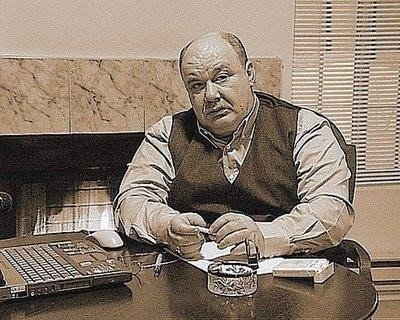
At the top of the sprawling criminal enterprise
was Semion Mogilevich.
Beginning in the early 1980s, according to the FBI, the short, squat Ukrainian was
the key money-laundering contact for the Solntsevskaya
Bratva, or Brotherhood, one of the richest criminal
syndicates in the world. Before long, he was running a multibillion-dollar
worldwide racket of his own. Mogilevich wasn’t feared
because he was the most violent gangster, but because he was reputedly the
smartest. The FBI has credited the “brainy don,” who holds a degree
in economics from Lviv University, with a staggering
range of crimes. He ran drug trafficking and prostitution rings on an
international scale; in one characteristic deal, he bought a bankrupt airline
to ship heroin from Southeast Asia into Europe. He used a jewelry business in
Moscow and Budapest as a front for art that Russian gangsters stole from
museums, churches, and synagogues all over Europe. He has also been accused of
selling some $20 million in stolen weapons, including ground-to-air missiles
and armored troop carriers, to Iran. “He uses this wealth and power to not only
further his criminal enterprises,” the FBI says, “but
to influence governments and their economies.”
In
Russia, Mogilevich’s influence reportedly reaches all
the way to the top. In 2005, Alexander Litvinenko, a
Russian intelligence agent who defected to London, recorded an
interview with investigators detailing his inside knowledge of the Kremlin’s
ties to organized crime. “Mogilevich,” he said in
broken English, “have good relationship with Putin since 1994 or 1993.” A year
later Litvinenko was dead, apparently poisoned by
agents of the Kremlin.
|
|
|
Vyachelsav Ivankov |
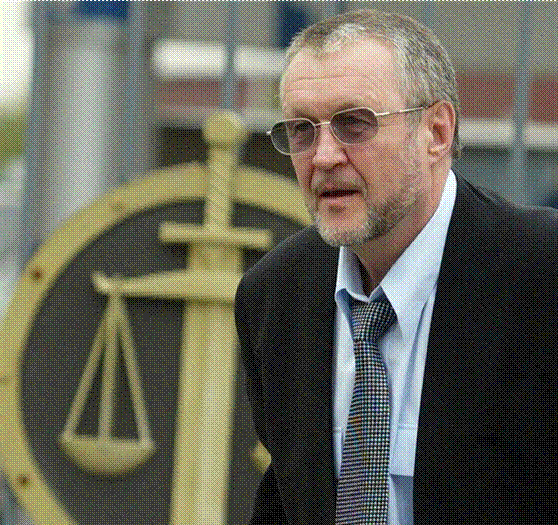
Mogilevich’s greatest talent, the one
that places him at the top of the Russian mob, is finding creative ways to
cleanse dirty cash. According to the FBI, he has laundered money
through more than 100 front companies around the world, and held bank accounts
in at least 27 countries. And in 1991, he made a move that led directly to
Trump Tower. That year, the FBI says, Mogilevich paid a Russian judge to spring a fellow mob
boss, Vyachelsav Kirillovich
Ivankov, from a Siberian gulag. If Mogilevich was the brains, Ivankov
was the enforcer—avorvzakone,
or “made man,” infamous for torturing his victims and boasting about the
murders he had arranged. Sprung by Mogilevich, Ivankov made the most of his freedom. In 1992, a year after
he was released from prison, he headed to New York on an illegal business visa
and proceeded to set up shop in Brighton Beach.
In
Red Mafiya,
his book about the rise of the Russian mob in America, investigative reporter
Robert I. Friedman documented how Ivankov organized a lurid and violent underworld of
tattooed gangsters. When Ivankov touched down at JFK,
Friedman reported, he was met by a fellow vor, who handed him a suitcase
with $1.5 million in cash. Over the next three years, Ivankov
oversaw the mob’s growth from a local extortion racket to a multibillion-dollar
criminal enterprise. According to the FBI, he recruited two “combat brigades”
of Special Forces veterans from the Soviet war in Afghanistan to run the
mafia’s protection racket and kill his enemies.
Like
Mogilevich, Ivankov had a
lot of dirty money he needed to clean up. He bought a RollsRoyce
dealership that was used,
according to The New York Times, “as
a front to launder criminal proceeds.” The FBI concluded that one of Ivankov’s partners in the operation was Felix Komarov, an upscale art dealer who lived in Trump Plaza on
Third Avenue. Komarov, who was not charged in the
case, called the allegations baseless. He acknowledged that he had frequent
phone conversations with Ivankov, but insisted the exchanges
were innocent. “I had no reason not to call him,” Komarov
told a reporter.
Trump
Taj Mahal paid the largest
fine ever levied against a casino for having “willfully violated”
anti-money-laundering rules.
The feds wanted to arrest Ivankov,
but he kept vanishing. “He was like a ghost to the FBI,” one agent recalls.
Agents spotted him meeting with other Russian crime figures in Miami, Los
Angeles, Boston, and Toronto. They also found he made frequent visits to Trump Taj
Mahal in Atlantic City, which mobsters routinely
used to launder huge sums of money. In 2015, the Taj Mahal was fined $10 million—the
highest penalty ever levied by the feds against a casino—and admitted to having
“willfully violated” anti-money-laundering regulations for years.
The
FBI also struggled to figure out where Ivankov lived.
“We were looking around, looking around, looking around,” James Moody, chief of
the bureau’s organized crime section, told Friedman. “We had to go out and
really beat the bushes. And then we found out that he was living in a luxury
condo in Trump Tower.”
There
is no evidence that Trump knew Ivankov personally,
even if they were neighbors. But the fact that a top Russian mafia boss lived
and worked in Trump’s own building indicates just how much high-level Russian
mobsters came to view the future president’s properties as a home away from
home. In 2009, after being extradited to Russia to face murder charges, Ivankov was gunned down in a
sniper attack on the streets of Moscow. According to The Moscow Times, his
funeral was a media spectacle in Russia, attracting “1,000
people wearing black leather jackets, sunglasses, and gold chains,” along with
dozens of giant wreaths from the various brotherhoods.

Throughout
the 1990s, untold millions from the former Soviet Union flowed into Trump’s
luxury developments and Atlantic City casinos. But all the money wasn’t enough
to save Trump from his own failings as a businessman. He owed $4
billion to more than 70 banks, with a mind-boggling $800 million of it
personally guaranteed. He spent much of the decade mired in litigation, filing
for multiple bankruptcies and scrambling to survive. For most developers, the
situation would have spelled financial ruin. But fortunately for Trump, his own
economic crisis coincided with one in Russia.
In
1998, Russia defaulted on $40 billion in debt, causing the ruble to plummet and
Russian banks to close. The ensuing financial panic sent the country’s
oligarchs and mobsters scrambling to find a safe place to put their money. That
October, just two months after the Russian economy went into a tailspin, Trump broke ground on his
biggest project yet. Rising to 72 stories in midtown Manhattan, Trump World Tower
would be the tallest residential building on the planet. Construction got
underway in 1999—just as Trump was preparing his
first run for the presidency on the Reform Party ticket— and concluded in 2001.
As
Bloomberg Businessweek reported earlier
this year, it wasn’t long before one-third of the units on the tower’s priciest
floors had been snatched up—either by individual buyers from the former Soviet
Union, or by limited liability companies connected to Russia. “We had big
buyers from Russia and Ukraine and Kazakhstan,” sales agent Debra Stotts told Bloomberg.
|
RHONA
WISE/AFP/GETTY |
|
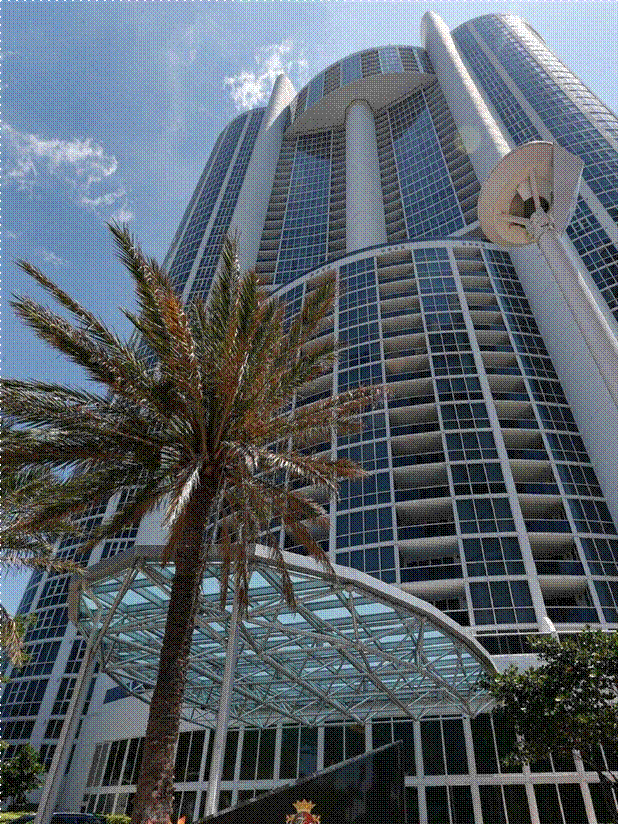
Sunny
Isles, Florida, became known as “Little Moscow,” thanks to Trump’s
high-rises. |
Among
the new tenants was Eduard Nektalov, a diamond dealer
from Uzbekistan. Nektalov, who was being investigated
by a Treasury Department task force for mob-connected money laundering, bought
a condo on the seventy-ninth floor, directly below Trump’s future campaign
manager, Kellyanne Conway. A month later he sold his
unit for a $500,000 profit. The following year, after rumors circulated that Nektalov was cooperating with federal investigators, he was shot down on
Sixth Avenue.
Trump had found his market. After Trump World
Tower opened, Sotheby’s International Realty teamed up with a Russian real
estate company to make a big sales push for the property in Russia. The “tower
full of oligarchs,” as Bloomberg
called it, became a model for Trump’s projects going forward. All he needed to
do, it seemed, was slap the Trump name on a big building, and high-dollar
customers from Russia and the former Soviet republics were guaranteed to come
rushing in. Dolly Lenz, a New York real estate broker, told USA Today that she sold some 65 units in
Trump World Tower to Russians. “I had contacts in Moscow looking to invest in
the United States,” Lenz said. “They all wanted to meet Donald.”
To
capitalize on his new business model, Trump struck a deal with a Florida
developer to attach his name to six high-rises in Sunny Isles, just outside Miami.
Without having to put up a dime of his own money, Trump would receive a cut of
the profits. “Russians love the Trump brand,” Gil Dezer,
the Sunny Isles developer, told Bloomberg.
A local broker told The
Washington Post that one-third of the
500 apartments he’d sold went to “Russian-speakers.” So many bought the
Trump-branded apartments, in fact, that the area became known as
“Little
Moscow.”
|
|
BILLY FARRELL/PATRICK MCMULLAN/GETTY; JOHN MARSHALL MANTEL/
NEW YORK TIMES/REDUX
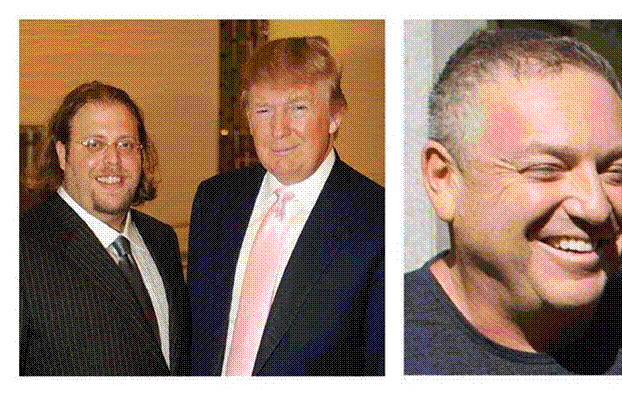
“Russians
love the Trump brand,” said developer Gil Dezer,
(left, with Trump). One Florida tenant, Anatoly Golubchik
(right) was busted in a major money-laundering ring run out of Trump Tower. |
Many
of the units were sold by a native of Uzbekistan who had immigrated
from the Soviet Union in the 1980s; her business was so brisk that she soon
began bringing Russian tour groups to Sunny Isles to view the properties.
According to a Reuters investigation in March, at
least 63 buyers with Russian addresses or passports spent $98
million on Trump’s properties in south Florida. What’s more, another one-third
of the units—more than 700 in all—were bought by shadowy shell companies that concealed
the true owners.
Trump promoted and
celebrated the properties. His organization continues to advertise the units;
in 2011, when they first turned a profit, he attended a
ceremonial mortgage-burning in Sunny Isles to toast their success. Last
October, an investigation by the Miami
Herald found that
at least 13 buyers in the Florida complex have been the target of government
investigations, either personally or through their companies, including
“members of a Russian-American organized crime group.” Two buyers in Sunny
Isles, Anatoly Golubchik and Michael Sall, were convicted for taking part in a massive
international gambling and money-laundering syndicate that was run out of
Trump Tower in New York.The ring, according to the
FBI, was operating under the protection of the Russian mafia.
The
influx of Russian money did more than save Trump’s business from ruin—it set
the stage for the next phase of his career. By 2004, to the outside world, it
appeared that Trump was back on top after his failures in Atlantic City. That
January, flush with the appearance of success, Trump launched his newly
burnished brand into another medium.
“My
name’s Donald Trump,” he declared in his opening narration
for The Apprentice, “the largest real
estate developer in New York. I own buildings all over the place. Model
agencies. The Miss Universe pageant. Jetliners, golf courses, casinos, and
private resorts like Mar-a-
Lago,
one of the most spectacular estates anywhere in the world.”
But
it wouldn’t be Trump without a better story than that. “It wasn’t always so
easy,” he confessed, over images of him cruising around New York in a stretch
limo. “About 13 years ago, I was seriously in trouble. I was billions of
dollars in debt. But I fought back, and I won. Big league. I used my brain. I
used my negotiating skills. And I worked it all out. Now my company’s bigger
than it ever was and stronger than it ever was.… I’ve mastered the art of the
deal.”
The
show, which reportedly paid Trump
up to $3 million per episode, instantly revived his career. “The Apprentice turned Trump from a blowhard Richie Rich who had just gone
through his most difficult decade into an unlikely symbol of straight talk, an
evangelist for the American gospel of success, a decider who insisted on
standards in a country that had somehow slipped into handing out trophies for
just showing up,” journalists Michael Kranish and
Marc Fisher observe in their book Trump Revealed. “Above all, Apprentice sold an image of the
host-boss as supremely competent and confident, dispensing his authority and
getting immediate results. The analogy to politics was palpable.”
Russians
spent at least $98 million on Trump’s properties in Florida—and another third
of the units were bought by shadowy shell companies.
But
the story of Donald Trump, self-made business genius, left out any mention of
the shady Russian investors who had done so much to make his comeback narrative
possible. And Trump’s business, despite the hype, was hardly “stronger than it
ever was”—his credit was still lousy, and two more of his prized properties in
Atlantic City would soon fall into bankruptcy, even as his ratings soared.
To
further enhance his brand, Trump used his prime-time perch to unveil another
big project. On the 2006 season finale of The
Apprentice, as 11 million viewers waited to learn which of the two
finalists was going to be fired, Trump prolonged the suspense by cutting to a
promotional video for his latest venture. “Located in the center of Manhattan’s
chic artist enclave, the Trump International Hotel and Tower in SoHo is the site of my latest development,” he narrated over
swooping helicopter footage of lower Manhattan. The new building, he added,
would be nothing less than a “$370 million work of art … an aweinspiring
masterpiece.”
Trump
SoHo was the brainchild of two development companies—Bayrock Group LLC and the Sapir Organization—run by a pair
of wealthy émigrés from the former Soviet Union who had done business with some
of Russia’s richest and most notorious oligarchs. Together, their firms made
Trump an offer he couldn’t refuse: The developers would finance and build Trump
SoHo themselves. In return for lending his name to
the project, Trump would get 18
percent of the profits—without putting up any of his own money.
One
of the developers, Tamir Sapir, had followed an
unlikely path to riches. After emigrating from the Soviet Union in the 1970s,
he had started out driving a cab in New York City and ended up a billionaire living
in Trump Tower. His big break came when he co-founded a company that sold
high-tech electronics. According to the FBI, Sapir’s partner in the firm was a
“member or associate” of Ivankov’s mob in Brighton
Beach. No charges were ever filed, and Sapir denied having any mob ties. “It
didn’t happen,” he told The New York Times. “Everything was done
in the most legitimate way.”
Trump,
who described Sapir
as a “great friend,” bought 200 televisions from his electronics company. In
2007, he hosted the
wedding of Sapir’s daughter at Mar-a-Lago, and later attended her infant son’s bris.
|
|
MARK VON HOLDEN/WIREIMAGE/GETTY
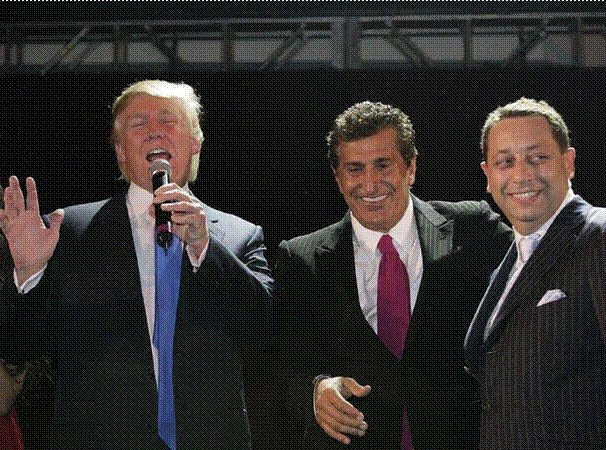
In
2007, Trump celebrated the launch of Trump SoHo
with partners Tevfik Arif
(center) and Felix Sater (right). Arif was later acquitted on charges of running a
prostitution ring. |
Sapir
also introduced Trump
to Tevfik Arif, his partner
in the Trump SoHo deal. On paper, at least, Arif was another heartwarming immigrant success story. He
had graduated from the Moscow Institute of Trade and Economics and worked as a
Soviet trade and commerce official for 17 years before moving to New York and
founding Bayrock. Practically overnight, Arif became a wildly successful developer in Brooklyn. In
2002, after meeting Trump, he moved Bayrock’s offices
to Trump Tower, where he and his staff of Russian émigrés set up shop on the
twenty-fourth floor.
Trump
worked closely with Bayrock on real estate ventures
in Russia, Ukraine, and Poland. “Bayrock knew the
investors,” he later testified. Arif “brought the people up from Moscow to meet with me.”
He boasted about the deal he was getting: Arif was
offering him a 20 to 25 percent cut on his overseas projects, he said, not to
mention management fees. “It was almost like mass production of a car,” Trump
testified.
But
Bayrock and its deals quickly became mired in
controversy. Forbes and other
publications reported that
the company was financed by a notoriously corrupt group of oligarchs known as
The Trio. In 2010, Arif was arrested by
Turkish prosecutors and charged with setting up a prostitution ring after he
was found aboard a boat—chartered by one of The Trio—with nine young women, two of whom
were 16 years old.
The women reportedly refused to talk, and Arif was
acquitted. According to a lawsuit filed that same year by two former Bayrock executives, Arif started the
firm “backed by oligarchs and money they stole from the Russian people.” In
addition, the suit alleges, Bayrock “was
substantially and covertly mob-owned and operated.” The company’s real purpose,
the executives claim, was to develop hugely expensive properties bearing the
Trump brand—and then use the projects to launder money and evade taxes.
The lawsuit, which is ongoing, does not claim
that Trump was complicit in the alleged scam. Bayrock
dismissed the allegations as “legal conclusions to which no response is
required.” But last year, after examining title deeds, bank records, and court
documents, the Financial Times concluded that
Trump SoHo had “multiple ties to an alleged
international money laundering network.” In one case, the paper reported, a
former Kazakh energy minister is being sued in federal court for conspiring to
“systematically loot hundreds of millions of dollars of public assets” and then
purchasing three condos in Trump SoHo to launder his
“illgotten funds.”
|
|
|
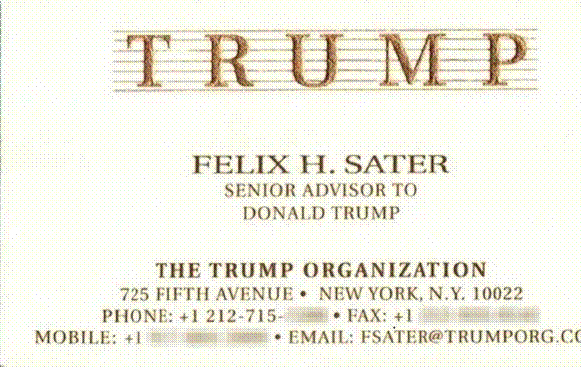
Felix Sater had a Trump business
card long after his criminal past came to light |
During
his collaboration with Bayrock, Trump also became
close to the man who ran the firm’s daily operations—a twice-convicted felon
with family ties to Semion Mogilevich.
In 1974, when he was eight years old, Felix Sater and
his family emigrated from Moscow to Brighton Beach. According to the FBI, his
father—who was convicted for extorting local restaurants, grocery stores, and a
medical clinic—was a Mogilevich boss. Sater tried
making it as a stockbroker, but his career came to an abrupt end in 1991, after
he stabbed a Wall
Street foe in the face with a broken margarita glass during a bar fight,
opening wounds that required 110 stitches. (Years later, in a deposition, Trump downplayed the
incident, insisting that Sater “got into a barroom
fight, which a lot of people do.”) Sater lost his
trading license over the attack, and served a year in prison.
In
1998, Sater pleaded guilty to racketeering—operating a
“pump and dump” stock fraud in partnership with alleged Russian mobsters that
bilked investors of at least $40 million. To avoid prison time, Sater turned informer. But according to the lawsuit against
Bayrock, he also resumed “his old tricks.” By 2003, the
suit alleges, Sater controlled the majority of Bayrock’s shares—and proceeded to use the firm to launder
hundreds of millions of dollars, while skimming and extorting millions more.
The suit also claims that Sater committed fraud by
concealing his racketeering conviction from banks that invested hundreds of
millions in Bayrock, and that he threatened “to kill
anyone at the firm he thought knew of the crimes committed there and might
report it.” In court, Bayrock has denied the
allegations, which Sater’s attorney characterizes as
“false, fabricated, and pure garbage.”
By
Sater’s account, in sworn testimony, he was very
tight with Trump. He flew to Colorado with him, accompanied Donald Jr. and Ivanka on a trip to Moscow at Trump’s invitation, and met
with Trump’s inner circle “constantly.” In Trump Tower, he often dropped by
Trump’s office to pitch business ideas—“just me and him.”
Trump seems unable to recall any of this.
“Felix Sater, boy, I have to even think about it,” he told the
Associated Press in 2015. Two years earlier, testifying in a video deposition,
Trump took the same line. If Sater “were sitting in
the room right now,” he swore under oath, “I really wouldn’t know what he
looked like.” He added: “I don’t know him very well, but I don’t think he was
connected to the mafia.”
Trump
and his lawyers say that he was unaware of Sater’s
criminal past when he signed on to do business with Bayrock.
That’s plausible, since Sater’s plea deal in the
stock fraud was kept secret because of his role as an informant. But even after
The New York Times revealed Sater’s criminal record in 2007, he continued to use office
space provided by the Trump Organization. In 2010, he was even given an
official Trump Organization business card that read: FELIX H. SATER, SENIOR
ADVISOR TO DONALD TRUMP.
In
2013, police burst into Unit 63A of Trump Tower and rounded up 29 suspects in a
$100 million money-laundering scheme.
Sater apparently remains close to Trump’s inner
circle. Earlier this year, one week before National Security Advisor Michael
Flynn was fired for failing to report meetings with Russian officials, Trump’s
personal attorney reportedly hand-delivered to Flynn’s office a “back-channel
plan” for lifting sanctions on Russia. The co-author of the plan, according to the Times: Felix Sater.
In
the end, Trump’s deals with Bayrock, like so much of
his business empire, proved to be more glitter than gold. The international
projects in Russia and Poland never materialized. A Trump tower being built in
Fort Lauderdale ran out of money before it was completed, leaving behind a
massive concrete shell. Trump SoHo ultimately had to
be foreclosed and resold. But his
Russian investors had left Trump with a high-profile property he could
leverage. The new owners contracted with Trump to run the tower; as of April,
the president and his daughter Ivanka were still listed as
managers of the property. In 2015, according to the federal financial
disclosure reports, Trump made $3 million from Trump SoHo.

In
April 2013, a little more than two years before Trump rode the escalator to the
ground floor of Trump Tower to kick off his presidential campaign, police burst into
Unit 63A of the high-rise and rounded up 29 suspects in two gambling rings. The
operation, which prosecutors called “the world’s largest sports book,” was run
out of condos in Trump Tower—including the entire fifty-first floor of the
building. In addition, unit 63A—a condo directly below one owned by
Trump—served as the headquarters for a “sophisticated moneylaundering
scheme” that moved an estimated $100 million out of the former Soviet Union,
through shell companies in Cyprus, and into investments in the United States.
The entire operation, prosecutors say, was working under the protection of Alimzhan Tokhtakhounov, whom the
FBI identified as a top Russian vor closely allied
with Semion Mogilevich. In
a single two-month stretch, according to the federal indictment, the money
launderers paid Tokhtakhounov $10 million.
Tokhtakhounov, who had been indicted a
decade earlier for conspiring to fix the ice-skating competition at the 2002
Winter Olympics, was the only suspect to elude arrest. For the next seven
months, the Russian crime boss fell off the radar of Interpol, which had issued
a red alert. Then, in November 2013, he suddenly appeared live on international
television—sitting in the audience at the Miss Universe pageant in Moscow. Tokhtakhounov was in the VIP section, just a few seats away
from the pageant owner, Donald Trump.
|
|
DMITRY KOROTAYEV/EPSILON/GETTY
Alimzhan Tokhtakhounov. |
After
the pageant, Trump bragged about all the powerful Russians who had turned out that
night, just to see him. “Almost all of the oligarchs were in the room,” he told Real
Estate Weekly. Contacted by Mother
Jones, Tokhtakhounov insisted that
he had bought his own ticket and was not a VIP. He also denied being a mobster, telling The New York Times that he had been
indicted in the gambling ring because FBI agents “misinterpreted his Russian
slang” on their Trump Tower wiretaps, when he was merely placing $20,000 bets
on soccer games.
Both the White House and the Trump Organization
declined to respond to questions for this story. On the few occasions he has
been questioned about his business entanglements with Russians, however, Trump
has offered broad denials. “I tweeted out that I have no dealings with Russia,”
he said at a
press conference in January, when asked if Russia has any
“leverage” over him, financial or otherwise. “I have no deals
that could happen in Russia, because we’ve stayed away. And I have no loans
with Russia. I have no loans with Russia at all.” In May, when he was interviewed by
NBC’s Lester Holt, Trump seemed hard-pressed to think of a single connection he
had with Russia. “I have had dealings over the years where I sold a house to a
very wealthy Russian many years ago,” he said. “I had the Miss Universe
pageant—which I owned for quite a while—I had it in Moscow a long time ago. But
other than that, I have nothing to do with Russia.”
But
even if Trump has no memory of the many deals that he and his business made
with Russian investors, he certainly did not “stay away” from Russia. For
decades, he and his organization have aggressively promoted his business there,
seeking to entice investors and buyers for some of his most high-profile
developments. Whether Trump knew it or not, Russian mobsters and corrupt
oligarchs used his properties not only to launder vast sums of money from
extortion, drugs, gambling, and racketeering, but even as a base of operations
for their criminal activities. In the process, they propped up Trump’s business
and enabled him to reinvent his image. Without the Russian mafia, it is fair to
say, Donald Trump would not be president of the United States.
Semion Mogilevich,
the Russian mob’s “boss of bosses,” also declined to respond to questions from
the New Republic. “My ideas are not
important to anybody,” Mogilevich said in a statement
provided by his attorney. “Whatever I know, I am a private person.” Mogilevich, the attorney added, “has nothing to do with
President Trump. He doesn’t believe that anybody associated with him lives in
Trump Tower. He has no ties to America or American citizens.”
Back
in 1999, the year before Trump staged his first run for president, Mogilevich gave a rare interview to the
BBC. Living up to his reputation for cleverness, the mafia boss mostly joked
and double-spoke his way around his criminal activities. (Q: “Why did you set
up companies in the Channel Islands?” A: “The problem was that I didn’t know
any other islands. When they taught us geography at school, I was sick that
day.”) But when the exasperated interviewer asked, “Do you believe there is any
Russian organized crime?” the “brainy don” turned half-serious.
“How can you say that there is a Russian mafia
in America?” he demanded. “The word mafia,
as far as I understand the word, means a criminal group that is connected with
the political organs, the police and the administration. I don’t know of a
single Russian in the U.S. Senate, a single Russian in the U.S. Congress, a single Russian in the U.S. government.
Where
are the connections with the Russians? How can there be a Russian mafia in
America? Where are their connections?”
Two
decades later, we finally have an answer to Mogilevich’s
question.

Craig Unger is a contributing editor at Vanity Fair and the author of several books, including House of Bush, House of Saud.
•
• This
article was copied from the The New Republic